
AI Has Commoditised Software Development. Marketing Is the New Moat
A year ago, launching a SaaS product required a development team, months of engineering effort and a significant budget. Today, a founder with an idea, an AI coding assistant and a subscription to platforms like Claude, ChatGPT, Cursor or Replit can build a working prototype over a weekend. AI-powered “vibe coding” has fundamentally changed software development by enabling entrepreneurs to describe an application in plain English while AI generates much of the underlying code.
This is an extraordinary shift.
But it has also created a dangerous illusion—that building the product is the hard part.
It isn’t.
The real challenge begins after the product is ready.
Imagine two founders.
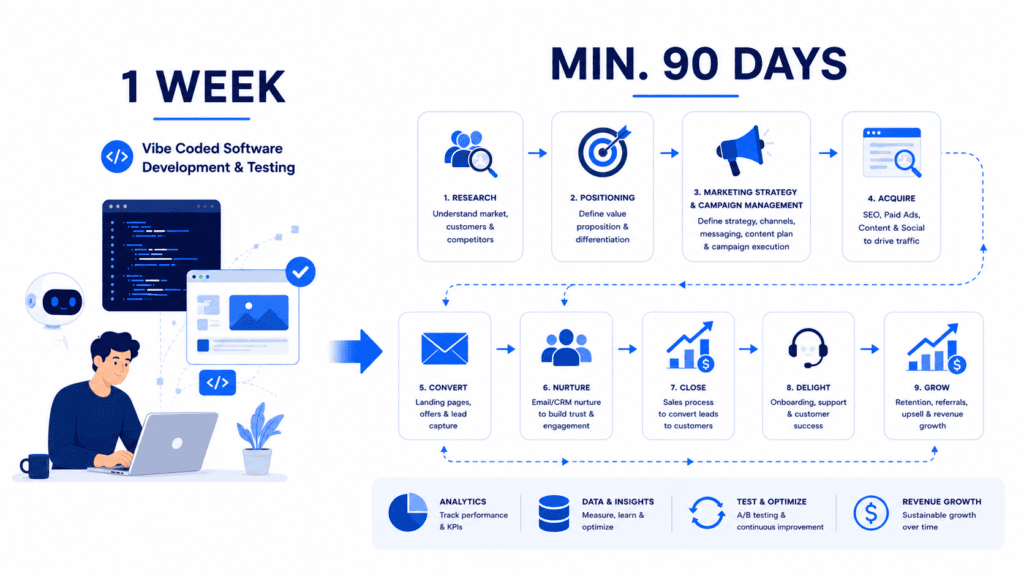
The first spends six hours building an AI-powered CRM for small businesses. The application works well, has a clean interface and solves a genuine problem.
The second spends the next twelve months identifying the right customer segment, refining positioning, creating educational content, investing in paid media, improving onboarding, supporting customers, reducing churn and continuously measuring conversion metrics.
Only one of them has built a business.
Technology has become a commodity. Customer acquisition has not.
AI has dramatically reduced the cost of software development, but it has not reduced Customer Acquisition Cost (CAC). It has not made customers trust a new brand overnight. It has not eliminated competition or created product-market fit. These are strategic problems, not engineering problems.
Every day, thousands of new AI tools and SaaS products are launched. Most disappear quietly—not because the technology was poor, but because they never found enough paying customers.
Marketing today is significantly more demanding than writing code.
It requires understanding customer psychology, defining a differentiated value proposition, investing in distribution, building credibility, analysing data, running experiments, optimising conversion rates and delivering consistent customer experiences. None of these can be solved by a single prompt.
This explains why many AI-built products receive praise on Product Hunt but struggle to generate recurring revenue six months later.
The winners in the AI era will not necessarily be the companies that build the fastest.
They will be the companies that understand their customers the best.
For founders, this changes investment priorities. Instead of allocating most of the budget to development, resources should increasingly flow towards growth strategy, content, brand building, demand generation, RevOps and customer success.
AI has democratised software creation.
It has not democratised sustainable growth.
The next competitive advantage is no longer the ability to build an application. Almost everyone can do that.
The competitive advantage is building a repeatable revenue engine that consistently attracts, converts and retains customers.
In the AI era, code is becoming cheaper.
Attention, trust and customer relationships are becoming more valuable than ever.