Performance Marketing Is Passe. Revenue Marketing Is Everything.
For years, marketing success was measured by clicks, leads and conversions. The next generation of marketing will be measured by something far more important: revenue.
There was a time when a marketing team could walk into a management meeting and announce:
“We generated 5,000 leads this month at ₹800 per lead.”
That was considered a good result. Today, a CEO is more likely to ask a different question:
“How much revenue did those leads generate?”
That seemingly simple question represents a fundamental shift in marketing. Performance marketing is not disappearing. Paid search, social advertising, SEO and conversion optimisation will remain important. But performance marketing as the definition of marketing performance is becoming inadequate.
The business does not ultimately need clicks. It needs customers, revenue and profitable growth. That is why the next evolution is Revenue Marketing.
The problem with optimising for leads
Performance marketing became popular for a good reason. It brought accountability to marketing. Instead of talking about vague measures such as “brand visibility”, marketers could measure impressions, clicks, leads, cost per acquisition and conversions.
That was a major improvement. The problem is what happened next. Over time, many organisations started optimising the entire marketing function around the metrics that digital platforms could measure most easily.
- CTR went up.
- CPC came down.
- CPL improved.
- Lead volumes increased.
The dashboard looked fantastic. But sometimes the business did not grow proportionately.
Why?
Because a lead is not a customer, and a customer is not necessarily profitable revenue.
Consider two campaigns.
- Campaign A generates 1,000 leads at ₹1,000 each. Twenty become customers.
- Campaign B generates 400 leads at ₹2,000 each. Forty become customers.
If the marketing team is measured on CPL, Campaign A looks like the winner. If the business is measured on customers and revenue, Campaign B may be significantly better. The difference is not in the advertising platform. It is in what the organisation chooses to optimise.
The buyer journey has moved beyond the marketing funnel
There is another reason this matters. Customers are increasingly doing their own research before they ever speak to a company. This is particularly visible in B2B.
The 2025 6sense B2B Buyer Experience Report, based on nearly 4,000 buyers, found that 95% of winning vendors were already on the buyer’s Day One shortlist. The vendor ranked first during the early selection phase ultimately won about 80% of the time.
Think about what that means. If a buyer has already researched your company, compared alternatives, spoken to peers, consumed your content and formed an opinion before submitting an enquiry, then the lead-generation campaign is only one small part of the equation. The real battle may already have been fought.
This means marketing has to influence the customer before the customer identifies themselves.
- Brand matters.
- Content matters.
- Search visibility matters.
- Customer reviews matter.
- Thought leadership matters.
- Website experience matters.
- Product positioning matters.
And, of course, performance marketing matters. But they have to work together.
From campaign optimisation to revenue optimisation
This is where Revenue Marketing changes the conversation. The traditional performance marketing question is: “Which campaign generated the cheapest conversion?”
The Revenue Marketing question is: “Which combination of audience, proposition, channel and customer experience generated the most profitable revenue?”
That is a much harder question. It also happens to be a much more valuable one. The metrics therefore move further down the funnel. CPC and CPL still have a role. They help marketers diagnose campaign efficiency. But the management dashboard should increasingly include:
- Customer Acquisition Cost
- Marketing-sourced pipeline
- Lead-to-opportunity conversion
- Opportunity-to-customer conversion
- Revenue by channel
- CAC payback period
- Customer Lifetime Value
- Retention and expansion
- Marketing ROI
The shift is subtle but important.
Campaign metrics tell you what happened inside marketing. Revenue metrics tell you what happened to the business.
The pressure on CMOs is increasing
This shift is not happening in isolation. Marketing leaders are facing a difficult combination of higher expectations, tighter budgets and rapid technological change.
Gartner’s 2026 CMO Spend Survey found that marketing budgets have remained almost flat, at 7.8% of company revenue, while CMOs are allocating an average 15.3% of their marketing budgets to AI initiatives. Yet only 30% reported that their organisations have mature or fully developed AI readiness capabilities.
The previous year’s Gartner research had already found that 59% of CMOs felt they did not have sufficient budget to execute their strategy.
This creates a very different environment for marketing leaders. The expectation is no longer simply:
“Can you generate demand?”
It is: “Can you generate growth efficiently, prove the commercial impact and continuously improve the economics?”
That requires marketing to become much more connected to the rest of the organisation.
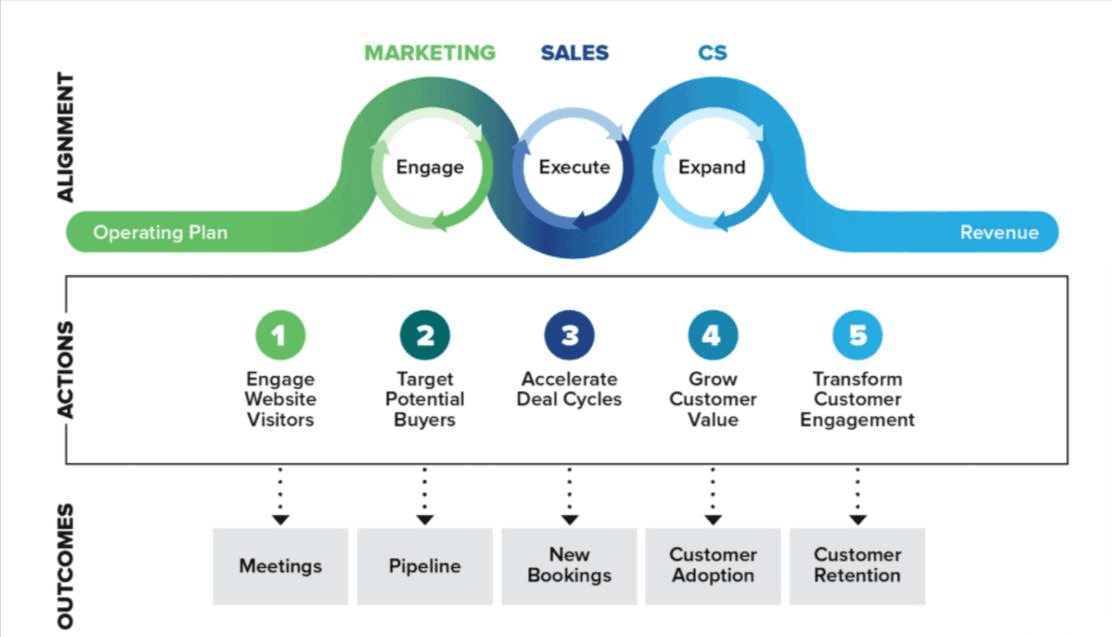
Revenue Marketing is a system, not another marketing channel
This is where I believe many organisations are getting the terminology wrong. Revenue Marketing is not another service to add alongside SEO, paid media, email marketing or content. It is the system that connects them.
Think of the journey as:
Strategy → Demand → Conversion → Automation → Revenue Operations → Retention → Expansion
- Paid media can create demand.
- Content can build consideration.
- The website can convert interest.
- CRM and automation can nurture prospects.
- Sales can convert opportunities.
- Customer success can protect retention.
- Data and RevOps can connect the entire journey.
- AI can increasingly optimise and automate activities across these stages.
The value comes from the connections between these functions, not from optimising each one independently. This is the difference between managing marketing activities and building a Revenue Growth System.
The AI factor makes this even more important
AI is accelerating the commoditisation of marketing execution.
- Generating ad variations is easier.
- Producing content is faster.
- Analysing campaign data is easier.
- Personalising communication is becoming more accessible.
- Automating repetitive marketing activities is becoming increasingly practical.
Gartner’s 2026 research found that 70% of CMOs consider becoming an AI leader a critical goal, but only 30% say their organisations are ready to scale AI capabilities. Gartner’s conclusion is particularly relevant: the challenge is not simply buying AI tools; organisations need the underlying data, processes, governance and talent to turn those tools into value.
This is an important distinction.
AI can make execution cheaper and faster. It does not automatically make the strategy better.
In fact, when everyone can produce more content, more campaigns and more creative variations, strategic clarity becomes even more important.
- Which customers should we target?
- What problem should we own?
- Which proposition should we take to market?
- Where should we invest?
- What should we automate?
- What should we measure?
And, ultimately, what creates profitable revenue?
Those are strategic questions.
What Revenue Marketing means for the CMO
The CMO’s role is therefore changing. The modern CMO cannot afford to operate only as the owner of advertising, content or brand. At the same time, marketing should not simply become an extension of the sales department. The opportunity is bigger.
The CMO should become one of the architects of the company’s growth system. That means understanding the economics of acquisition. Understanding the customer journey. Connecting marketing and sales data. Identifying where prospects are being lost. Improving conversion. Using automation intelligently. Building retention and expansion mechanisms. And making investment decisions based on commercial outcomes rather than channel preferences. This does not mean every CMO needs to become a data scientist or personally manage every marketing channel.
It means the CMO needs to understand how all the pieces fit together.
Performance marketing still matters. But it belongs inside the system.
This is perhaps the most important clarification. I am not suggesting that companies should stop running Google or Meta campaigns. Nor am I suggesting that CPL, ROAS or conversion rates no longer matter. They do. But they are inputs and diagnostic measures, not the final definition of growth. A campaign with excellent ROAS can still be strategically weak if it is exhausting a small audience. A campaign with a high CPL can still be valuable if it produces high-LTV customers. A channel with poor last-click attribution can still influence buyers earlier in their journey. And a lead that looks expensive at the top of the funnel can become highly profitable over a three-year customer relationship. This is why revenue cannot be understood by looking at individual campaigns in isolation.
The unit of optimisation needs to move from the campaign to the customer and ultimately to the business.
The next marketing advantage will be integration
For the last decade, competitive advantage often came from becoming better at individual channels.
- Better Facebook advertising.
- Better Google Ads.
- Better SEO.
- Better email marketing.
- Better landing pages.
That expertise will continue to matter. But increasingly, the advantage will come from something harder to replicate: connecting the channels, data, technology, people and processes into one growth system. A company that understands its customers better can target them better. A company that connects marketing and sales data can allocate budgets better. A company that understands its conversion bottlenecks can grow without simply increasing media spend. A company that uses automation intelligently can scale without adding proportional headcount. And a company that measures revenue rather than activity can make better decisions about where to invest. That is the real opportunity behind Revenue Marketing.
The question every CEO should ask
The next time your marketing team presents its monthly performance, don’t stop at leads, clicks or cost per acquisition.
Ask:
- How much qualified pipeline did marketing create?
- How much revenue did it generate?
- Which customers did we acquire?
- What did those customers cost us?
- Which channels are producing the best economics?
- Where are prospects falling out of the journey?
- What can we change to improve the system?
Those questions will tell you much more about the health of your marketing engine than a dashboard full of campaign metrics. Performance marketing gave marketing a much-needed culture of measurement.
Revenue Marketing takes that principle one step further.
It connects measurement to the outcome that ultimately matters to every business: profitable, sustainable growth. The future of marketing is therefore not about choosing between brand and performance, or between marketing and sales. It is about building a connected Revenue Growth System where strategy, demand generation, conversion, automation, RevOps, customer experience and AI work together. Performance marketing is still one of the engines.
But revenue is the destination.