
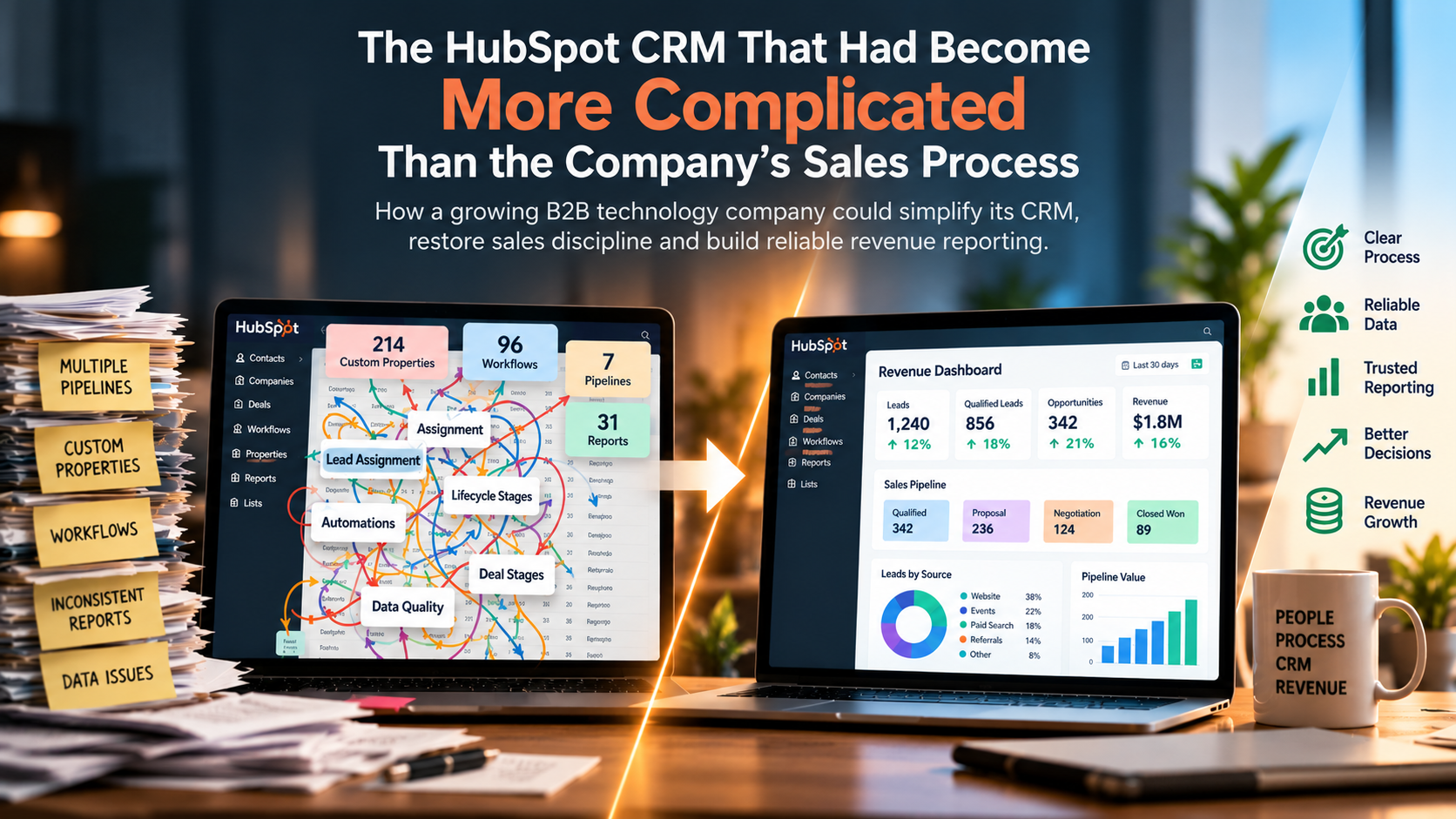
The HubSpot CRM That Had Become More Complicated Than the Company’s Sales Process
How a growing B2B technology company could simplify its CRM, restore sales discipline and build reliable revenue reporting.
The Business Situation
A growing B2B technology company had invested in HubSpot to bring its marketing and sales activities under one roof. The platform was expected to help the company manage inbound leads, automate follow-ups, track opportunities and give management a clear view of the sales pipeline.
Three years later, the company had 48,000 contact records, 6,200 company records, seven deal pipelines, 214 custom properties, 96 workflows and 31 management reports.
The investment had made the system more sophisticated, but not necessarily more effective.
Marketing complained that leads were being assigned incorrectly. Sales representatives maintained their own spreadsheets because they did not trust the CRM reports. Managers spent hours reconciling pipeline numbers before review meetings, while the marketing head could not confidently explain how many campaign-generated leads had become genuine sales opportunities.
The leadership team concluded that HubSpot needed further automation and a new set of dashboards.
However, before approving additional development, the company decided to investigate why an increasingly sophisticated CRM was making routine business activities more difficult.
The question was straightforward: Why had a system intended to improve sales productivity become another source of operational complexity?
The Investigation: Finding the Problems Behind the Numbers
The first step was not to redesign the dashboards or delete unused properties. It was to establish how the existing system was being used and where it was failing the business.
The audit covered contact and company records, deal pipelines, custom properties, workflows, lead assignment rules and management reports. It also involved discussions with the marketing team, sales representatives and the CRM administrator.
Four problems emerged in the scenario.
1. The Database Was Large, but Its Reliability Was Uncertain
Of the 48,000 contacts, the audit identified approximately 5,800 potential duplicate records, representing 12.1% of the database. These were candidates for investigation rather than records that could be deleted automatically; some contacts sharing a name or company could legitimately be different people.
A further 9,600 contacts had no assigned owner, while 13,400 lacked one or more fields required for the company’s lead qualification and routing process.
These issues affected different activities. Duplicate records could fragment engagement history, missing ownership could leave sales follow-ups unattended, and incomplete qualification data could prevent leads from being routed correctly.
The company had treated these as data-cleaning issues. In reality, they were also sales-process issues.
For example, if a prospect submitted a second enquiry using a different email address, the CRM might create another contact record. One record could be assigned to a salesperson while the other remained unassigned. Marketing could count two contacts, Sales could see only one active conversation, and management could struggle to reconcile the resulting activity. The immediate requirement was therefore not to clean every record indiscriminately. It was to establish which data problems were affecting lead management, reporting and commercial decisions.
2. Seven Pipelines Reflected Seven Interpretations of the Sales Process
The company had created seven deal pipelines for different products, customer segments and sales teams.
However, several pipelines used different stage names for broadly similar activities. One used “Qualified”, another used “Discovery Completed”, while a third used “Proposal in Progress” as the first meaningful sales stage.
The problem was not that seven pipelines were inherently excessive. Different sales motions may legitimately require different pipelines.
The definitions of what had to happen before a deal entered or exited each stage.
As a result, managers could not reliably compare conversion rates or deal ageing across teams. A deal classified as being at the proposal stage in one pipeline might represent an earlier level of commercial maturity than a deal at the same stage in another.
The company was measuring pipeline activity without consistently defining pipeline progress.
3. Ninety-Six Workflows Had Created Dependencies Nobody Fully Understood
The workflow audit found 96 workflows, of which 29 had no clearly documented business owner. Another 18 appeared to have overlapping responsibilities or dependencies that required investigation.
For example, a contact’s status could be updated by one workflow following a form submission and then changed by another workflow based on a sales activity or property update.
The result could be inconsistent reporting, unexpected record changes or repeated notifications. The audit would need to establish the actual execution paths before attributing any specific error to a workflow.
The team had also introduced automation to compensate for unclear operating rules. Instead of agreeing on when a lead should be assigned, accepted or marked as unqualified, different workflows had gradually acquired pieces of that responsibility.
The company was attempting to automate decisions that had never been properly standardised.
4. Thirty-One Reports Produced Numbers That Management Could Not Reconcile
The marketing dashboard showed 1,240 leads for the previous month. The sales dashboard showed 1,087 new leads, while the monthly management report referred to 1,165.
One report might count unique contacts created during the month, another might count leads entering a particular lifecycle stage, and a third might include records reactivated from an earlier period.
All three could be technically correct while answering different questions. The real problem was that management had not agreed on a common definition of a lead for monthly performance reporting.
Consequently, discussions focused on reconciling numbers rather than understanding why qualified leads were or were not progressing into opportunities.
The Root Cause: The Company Had Automated Its History Instead of Designing Its Process
The investigation pointed to a common underlying issue: the CRM had evolved overtime through individual requests from different teams at different times, without sufficient control over the business definitions and dependencies connecting those requests.
A campaign manager needed a new property, so one was created. A sales manager wanted another pipeline, so another was added. A reporting requirement led to another dashboard. A follow-up problem resulted in another workflow.
Each change addressed an immediate requirement. Over time, however, the cumulative effect was a system with overlapping rules, inconsistent definitions and limited accountability.
The company did not need to remove complexity simply for the sake of having fewer properties or workflows. It needed to remove complexity that did not contribute to a defined business outcome.
The Solution: Fix the Specific Problems Before Building Anything New
The consulting engagement was structured around four connected workstreams. Each addressed a problem identified during the audit, with clear ownership and measurable acceptance criteria.
Workstream 1: Restore Trust in the Contact Database
The first priority was to prevent avoidable data-quality problems from continuing to accumulate.
The team would export the relevant records and establish a recoverable baseline before making changes. It would then identify duplicate candidates using combinations of email addresses, company associations and other relevant identifiers.
Confirmed duplicates would be merged according to an agreed procedure, preserving important engagement history and associations wherever possible. Ambiguous cases would be referred for manual review rather than automatically deleted.
Next, the team would investigate the 9,600 unassigned contacts. Not all required sales ownership: newsletter subscribers, inactive contacts and other records might legitimately remain outside the active sales process.
The business would therefore define which contacts required an owner and establish routing rules for those records. For the 13,400 contacts with incomplete qualification data, the team would distinguish mandatory fields from optional information and identify which gaps could be resolved from existing data.
The target was not a perfectly complete database. It was a database reliable enough to support the company’s priority processes.
Proposed acceptance criteria:
- Reduce confirmed duplicate contact records to below 2% of the active contact database.
- Ensure at least 95% of records requiring sales ownership have a valid owner.
- Achieve at least 90% completion for mandatory lead qualification fields among records eligible for sales routing.
- Document exceptions, including records that legitimately do not require an owner or complete qualification data.
These are proposed targets to be validated against the audit baseline, not guaranteed outcomes.
Workstream 2: Standardise the Sales Process Across Pipelines
The company would retain separate pipelines where the underlying sales motions genuinely differed. It would not force every product or segment into one pipeline simply to reduce the count.
Instead, the sales leadership team would agree on a common set of principles for defining pipeline stages.
For example, a deal should not enter a proposal stage merely because a salesperson has sent a document. The company might require evidence that the business need has been confirmed, the relevant decision-makers have been identified and the commercial opportunity has been qualified.
The precise entry criteria would vary by sales motion, but each stage would have an explicit definition, required information and an identifiable exit condition.
The team would then map the seven existing pipelines against these rules, consolidate redundant stages where appropriate and correct inconsistent stage definitions.
Open deals would be reviewed individually. Deals with no recent activity, missing close dates or no credible next step would be returned to the salesperson for review rather than automatically moved to another stage.
The purpose was to make pipeline status meaningful enough for sales management and forecasting.
Proposed acceptance criteria:
- Ensure 100% of active pipeline stages have documented entry and exit criteria.
- Ensure at least 95% of active deals have an owner, deal amount where applicable, expected close date and next action.
- Ensure every open deal beyond its defined inactivity threshold is flagged for review.
- Establish comparable stage-conversion and deal-ageing reports for pipelines with sufficiently similar sales motions.
This would allow managers to identify stalled opportunities and inconsistent selling practices instead of relying on activity counts alone.
Workstream 3: Rationalise the 96 Workflows
The workflow remediation would begin with a dependency register, not a bulk deletion exercise.
For each workflow, the team would record its business purpose, owner, enrolment conditions, actions, associated properties and dependencies on other workflows or integrations.
The 96 workflows would then be classified into four groups: retain, repair, consolidate or retire.
Consider a lead assignment process that involved three workflows. One assigned an owner based on geography, another reassigned the contact based on company size, and a third created a follow-up task. The correct solution would depend on the intended business rules and execution order.
If geography and company size were both relevant to assignment, the rules would be combined into a clearly defined decision process. If task creation was independent, it could remain separate. If one workflow duplicated another without adding business value, it could be consolidated or retired.
The team would also review re-enrolment conditions, exceptions and conflicting property updates. Every material change would be tested against representative records before being deployed.
Importantly, a workflow would not be considered redundant simply because it had not executed recently. It might support an infrequent but important business event.
Proposed acceptance criteria:
- Assign an accountable owner and documented business purpose to 100% of retained workflows.
- Resolve all identified critical workflow conflicts before production deployment.
- Reduce overlapping workflows where consolidation preserves the required business logic.
- Validate all critical lead-routing and follow-up scenarios before release.
- Track workflow failures and unexpected record changes through a defined monitoring process.
The number of workflows removed would be a secondary measure. The primary objective would be reliable execution of the business processes they support.
Workstream 4: Rebuild the Management Reporting Around Decisions
The reporting workstream would begin by agreeing on definitions for leads, qualified leads, sales-accepted leads, opportunities and revenue. For example, the monthly lead report would specify whether it counted unique contacts created during the period, leads reaching a defined lifecycle stage or another explicitly agreed measure.
The team would then map each management KPI to its underlying CRM properties, records, filters and reporting period. Where two reports measured different things, they would be labelled accordingly rather than artificially forced to match.
The 31 existing reports would be reviewed against actual management decisions. Reports that duplicated other views or were no longer used would be retired. The remaining reports would be consolidated into a smaller set of operational and executive views.
The CEO’s dashboard would answer questions such as:
- How many qualified leads entered the sales process this month?
- What proportion were accepted by Sales?
- How many became genuine opportunities?
- How much qualified pipeline was created?
- Which opportunities are stalled or at risk?
- What revenue was won, and how does it compare with the company’s target?
The marketing team would retain more detailed reports for campaign performance and lead-source analysis. Sales managers would receive views focused on ownership, follow-up and pipeline progression.
Each report would have a defined purpose, owner and refresh frequency.
Proposed acceptance criteria:
- Reconcile the agreed lead and opportunity measures to their underlying CRM records.
- Eliminate unexplained discrepancies between reports measuring the same population, period and metric.
- Ensure 100% of executive KPIs have documented definitions and identifiable data sources.
- Reduce the 31 reports to a smaller, agreed set based on actual management and operational requirements.
The final number of reports would be determined by business needs, not by an arbitrary reduction target.
The Usual Ten-Week Implementation Plan
| Week | Activities | Deliverable |
| 1-2 | Audit records, pipelines, workflows and reports; establish baselines and dependencies. | Prioritised remediation register and agreed KPI definitions. |
| 3-4 | Finalise ownership rules, qualification requirements and pipeline stage definitions. | Approved sales-process design and data-governance rules. |
| 5-6 | Clean priority records, correct routing rules and remediate high-impact workflows. | Tested contact data, ownership and lead-management processes. |
| 7-8 | Standardise pipeline stages, review active deals and rebuild priority reports. | Consistent pipeline information and validated management reporting. |
| 9-10 | Complete regression testing, train users, document ownership and establish monitoring. | Controlled production release and operational handover. |
This is an indicative timeline, and actual time may differ depending upon the complexities, size of operations, size of company, integration failures, complex historical-data issues or significant sales-process redesign.
Changes would be deployed in controlled batches, with rollback arrangements for material changes. The business should not risk disrupting lead assignment or sales activity merely to meet an arbitrary deadline.
How to determine the Remediation Worked?
The company would compare the post-remediation position against the baseline established during the audit. The first review would focus on system and process reliability; commercial outcomes would be assessed over a longer period.
| KPI | Illustrative baseline | Proposed target | Review period |
| Confirmed duplicates as a percentage of active contacts | 12.1% potential duplicate candidates | Below 2% confirmed duplicates | Weekly during cleanup |
| Assigned ownership for contacts requiring sales follow-up | 80% if all 9,600 unassigned contacts are eligible; eligibility must be validated | At least 95% | Weekly |
| Completion of mandatory qualification fields | To be measured during audit | At least 90% | Weekly |
| Active deals meeting required data standards | To be measured during audit | At least 95% | Weekly |
| Active pipeline stages with documented entry and exit criteria | Inconsistent across seven pipelines | 100% | At implementation sign-off |
| Critical workflow scenarios passing agreed tests | To be measured during audit | 100% before release | At implementation sign-off |
| Unexplained discrepancies between reports measuring the same KPI | Three illustrative lead counts differ, but their definitions must first be reconciled | Zero unexplained discrepancies | Monthly |
| Median time from qualified lead creation to first sales response | To be established from reliable timestamps | Target agreed after baseline analysis | Weekly |
| Qualified-lead-to-opportunity conversion rate | To be established from consistently defined records | Improve against baseline without reducing lead quality | Monthly and quarterly |
The first seven measures assess the reliability of the CRM and the processes it supports. The final two test whether the improvements are helping Sales respond faster and convert qualified leads more effectively.
Learning: Do Not Confuse More Technology With Better Execution
The company’s difficulty was not that HubSpot had too many features. It was that the organisation had allowed individual requirements to accumulate without consistently evaluating their combined effect on the sales process.
More properties could not resolve unclear qualification criteria. More workflows could not compensate for conflicting ownership rules. More dashboards could not correct inconsistent metric definitions.
The solution was to simplify the way the business operated, then configure the CRM to support that process.
This principle applies beyond HubSpot. A CRM, marketing automation platform or AI agent is an enabler of business outcomes. Its value depends on whether it helps people make better decisions, execute processes reliably and convert demand into profitable revenue.
Before investing in another workflow, integration or dashboard, management should ask three questions: What business problem are we solving? Is the underlying process clearly defined? And how will we measure whether the change improved the outcome?
For a growing business, the objective is not to build the most sophisticated CRM. It is to build a system that employees can use confidently, managers can trust and leadership can connect to revenue.
That is the difference between managing a technology platform and engineering a revenue growth system.
Note: This is an illustrative case study. The names, company details, volumes, diagnostic findings and proposed performance targets have been changed to maintain the privacy of source.